How can progesterone testing help dog breeders Kurt De Cramer* BVSc MMedVet (Gyn) PhD *Email address: kdcramer@mweb.co.za. Rant en Dal Animal Hospital, 51 Cecil Knight Street, Mogale City, Gauteng, South Africa 1. Introduction Most veterinary practitioners have limited access to bitches that are in oestrus and they may lack the experience or the skills to interpret reproductive examinations such as vaginal speculum examinations (appearance of the vaginal mucous) and vaginal smears. Progesterone concentrations (PC) can aid both experienced and less experienced practitioners with reproductive consultations Although progesterone assays have been locally available for some years, the turnaround time impedes its usefulness in cases where immediate clinical decisions need to be made. Point of care (in-house) progesterone assays in South Africa are now a reality with one product currently available and various others forthcoming. Experienced dog breeders are well aware of the value of progesterone testing. It is recognised that, in the dog, up to 75% of failures to conceive can be attributed to incorrect timing of breeding. The reason why it is so difficult to time ovulation, in the absence of hormone testing, is because the stages of the canine oestrous cycle vary considerably in length. Pro-oestrus is defined as the period from onset of vulvar bleeding to the first acceptance of copulation and its duration averages 9 days but it can range from 1–27 days, in extreme cases. Pro-oestrus is followed by oestrus. Oestrus refers to the stage where the bitch shows outward signs of receptivity and it is the stage during which the bitch allows mating. Oestrus averages 9 days but it can range from 3–21 days, in extreme cases. These extreme variations have led to the belief that the bitch’s heat cycle is very elastic and variable. It is only in late oestrus that the bitch ovulates and that eggs become fertilizable, a couple of days later. Fertilisation typically occurs between 3-4 days preceding the end of oestrus. The problem is that, in observing a bitch during her heat cycle there is no way of knowing when the end of oestrus will be. To complicate matters some bitches may bleed throughout their entire heat period whereas other may not. Furthermore, some bitches may stand willingly, even long before there are eggs available for fertilisation, whilst others may only be receptive for a day or two. Certain bitches may not be willing to stand for a stud at all because they only stand for a particular stud. There are many other variations and idiosyncratic behaviours that can confuse the breeder, all contributing to a missed opportunity to breed the bitch successfully. There is a common misconception amongst breeders that the duration of the different stages within a heat cycle and the point at which a bitch will allow copulation replicates itself in each repeating heat cycle of each individual bitch. The breeder then uses the data from a previous cycle and applies it to the next cycle. For instance, because a bitch was previously successfully bred on day 10 (starting from first signs of heat), the breeder will keep on mating that specific bitch on day 10. Whilst this might work in some cases it most certainly won’t in all cases. Similarly, it is not always true that the stud can sniff out exactly when the bitch is at her peak (optimum time for fertilisation). More precise timing of the breeding events are required when there is limited access to the stud or artificial reproductive techniques are going to be used or when the quality of the semen is questionable. The ability to accurately time breeding is of practical and economic importance to breeders. Optimal timing helps breeders in the following ways:
2. Hormonal events during the bitch’s heat cycle
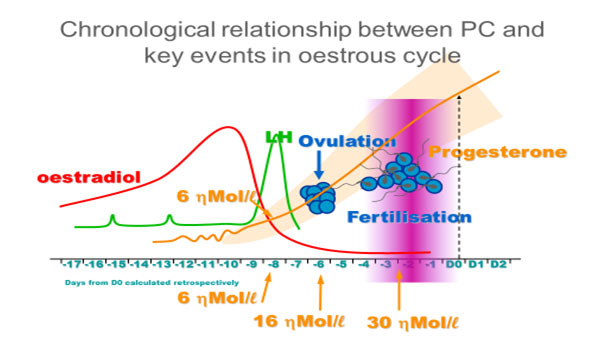
Figure 1
As seen in the figure above, progesterone starts to rise just before ovulation, towards the last week of the heat cycle. It is well established that as soon as the progesterone levels are around 6 nmol/L that the ovulation hormone (LH) peaks and that ovulation takes place 2 days later when the progesterone levels are around 16–25 nmol/L. Canine eggs cannot be fertilised immediately after ovulation because they need two days to mature and by that time the progesterone levels usually average 30 nmol/L or above. The table below can be used to correctly time the best days for matings or inseminations using fresh semen.
1. Other methods used to monitor the oestrus cycle in order to optimise the time of breeding in the bitch As mentioned, the behavioural signs of heat can be very misleading and reveal very little else other than the fact that the bitch is indeed in heat. Over the years, many methods have been made available to veterinarians and breeders to assist them in the timing of ovulation and breeding. These methods measured the vaginal Ph, salinity, electrical conductivity or resistance, ferning patterns in the vaginal mucous, glucose content and other parameters. The results of these methods did not correlate well with the actual time of ovulation. Also, progesterone test kits that performed semi quantitative evaluation of the progesterone concentration proved much less useful and reliable than quantitative assays that give an accurate progesterone concentration numerical value. Vaginal smears are only useful to confirm that the bitch is in heat and to see if there is pathology such as a severe vaginitis. Vaginal smears cannot accurately reflect the bitch’s heat cycle; it cannot indicate at what point in the heat cycle the bitch is, when a mating should take place or indeed predict in how many days her heat cycle will be over. Vaginal smears are however very useful in determining when the bitch is off heat and this again is very helpful to accurately determine the date of whelp. Vaginal speculum examinations is an acceptable oestrous monitoring tool, in the hands of experienced operators. It guides clinicians as to when they should start collecting blood samples for progesterone assay, especially in instances when breeding with fresh semen of good quality is envisaged 2. Number progesterone tests that are required to assess the heat cycle and subsequent decision making Financial constraints and also the inconvenience and time it takes to keep on presenting the bitch may limit the number of assays the veterinarian is permitted to perform. In some cases the breeder might present a bitch too late in her heat cycle to allow for serial blood sampling in order to plot a progesterone curve. Even so, experienced practitioners, that are familiar with vaginoscopic examinations, are When the value of a single progesterone is around 20 nmol/L during oestrus or thereabouts, then the timing is likely to be more reliable and good results can be obtained when using fresh semen breeding. However even under these circumstances, a single progesterone reading is generally not advised. For critical breeding’s (compromised semen, chilled or frozen semen), an accurate estimation of the optimum time of fertilisation is best achieved using 3–4 or, if required, even more progesterone assays in order to cover the key events of the LH peak, ovulation and onset of the fertile period. 3. Interval between blood collection to monitor the oestrous cycle The number of blood collections and on what days the collections should occur relies on the experience of the practitioner. Experienced practitioners are more likely to identify the stage of the cycle where the progesterone is likely to rise (and continue to rise) than less experienced practitioners. Less experienced practitioners are therefore advised to start collecting blood earlier in the oestrous cycle rather than later. During pro-oestrus and early oestrus, the progesterone level may remain close to basal up to around 3 nmol/L for many days (10 days or longer). At this stage the interval between collection may be extended to around four days. However as soon as the bitch starts to exhibit authentic signs of oestrus, blood collection and assay should be performed every second day. As soon as the progesterone has risen above 6 nmol/L the practitioner may elect to collect blood daily or at least every second day to confirm a sharp and continued rise to 20 nmol/L or above. 4. Progesterone and pregnancy The progesterone concentration increases to peaks of 47–286 nmol/L at mid-pregnancy and then gradually declines until it falls abruptly just prior to parturition or the end of dioestrus in the non-pregnant bitch. The progesterone profile of pregnant and non-pregnant bitches does not differ significantly and therefore progesterone cannot be used for pregnancy diagnosis. However, progesterone levels above 8.3 nmol/L are required throughout the entire pregnancy to maintain pregnancy. Hypoluteodism is a condition where the progesterone levels become too low and the bitch either aborts or resorbs. Serum progesterone should be monitored every 1 to 2 weeks in bitches with a history of pregnancy failure or luteal insufficiency. Supplementation of progestogens should be done with caution and must be discontinued before the expected parturition date to avoid prolonged gestation and foetal demise. 5. Progesterone and whelping Progesterone concentrations in the period around ovulation has value in that it assists with the prediction of whelping dates. In one study it was found that the date on which PC first exceeded 5.7 nmol/L (approximately 6), predicted the day of parturition within ±1 d, ± 2 d and ±3 d with a precision of 67%, 90% and 100% respectively. Pregnancy lengths based on time of the LH surge (synonymous with PC of ≈6 nmol/L), ovulation (15.9–25.4 nmol/L) and fertilization (≈ 32 nmol/L) are respectively 65 days, 63 days, and 61 days with the latter two being less accurate than the former. If progesterone is below 8.7 nmol/L, there is a 99% probability of whelp within 48 h and if the level is below 3.18 nmol/L this probability is 100%. Conversely, if the progesterone is 15.8 nmoL/L or above, the probability of onset of spontaneous parturition within the following 12 h is less than 2%. The table below assists with progesterone interpretations around the preparturient period in pregnant bitches
6. Conclusions
Progesterone is a useful tool in the reproductive consultation. The results of progesterone assays and its interpretation should however always be correlated to clinical observations and made in consultation with the breeder’s veterinarian. To change your subscription, click here.
|
|||||||||||||||||||||||||||||
| |